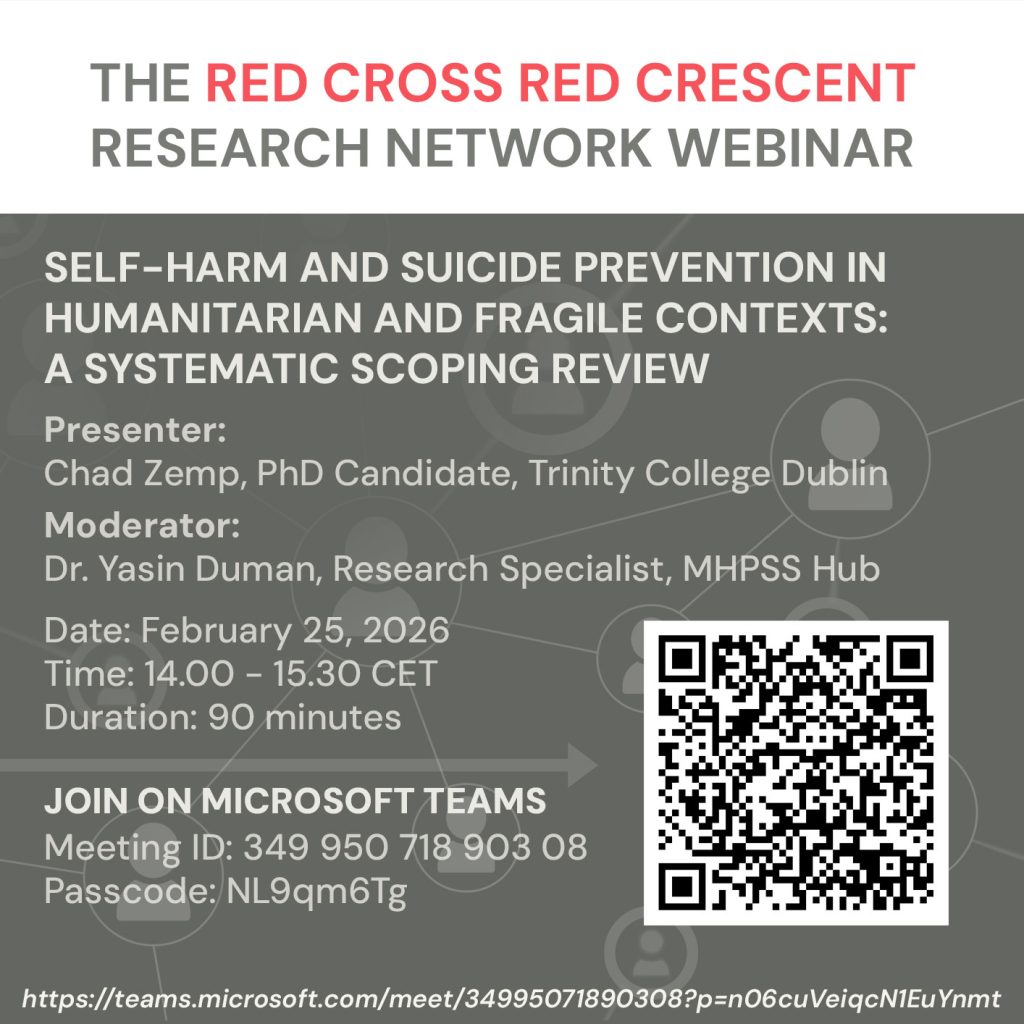
- Speaker: Chad Zemp, PhD Candidate at Trinity College Dublin
- Moderator: Dr. Yasin Duman, Research Specialist at MHPSS Hub
Pre-read:
Zemp, C., Vallières, F., Broecker, F., Haroz, E. E. E., Kakish, I., Sheaf, G., Lee, J. S. Y., Harrison, S., & Siersbaek, R. (2025). Self-harm and suicide prevention in humanitarian and fragile contexts: A systematic scoping review. Global mental health (Cambridge, England), 12, e145. https://doi.org/10.1017/gmh.2025.10108
This webinar aims to:
- Present and discuss the key findings of a systematic scoping review on self-harm and suicide prevention in humanitarian and fragile contexts,
- Identify and synthesise evidence from suicide and self-harm prevention interventions implemented in all types of humanitarian settings, globally, that have been evaluated for their effectiveness in improving suicide and self-harm-related outcomes.
Abstract:
Suicide remains one of the leading causes of death globally, with growing evidence that humanitarian emergencies and fragile states, most of which unfold in low- to middle-income countries (LMICs), are associated with elevated risk of suicide. However, the few suicide-targeted interventions for use in humanitarian contexts remain both sparse and fragmented. This scoping review aims to identify and synthesise evidence from suicide and self-harm prevention interventions implemented in all types of humanitarian settings, globally, that have been evaluated for their effectiveness in improving suicide and self-harm-related outcomes. We systematically searched eight electronic databases, including two grey literature databases, and relevant organisational websites for records published through November 2024 and in any language. Screening was done using the Covidence platform, with each record independently screened by two reviewers. Among other preselected inclusion criteria, studies must have conducted a quantitative evaluation of the effectiveness of an intervention on improving suicide and self-harm-related outcomes during a humanitarian crisis to be included for data extraction. Data extraction and quality assessment were both conducted by two authors. In all, 6,209 records were screened at the title and abstract phase; 104 were included for full text screening; and 23 studies were included for data extraction. Most studies were conducted during the coronavirus disease 2019 pandemic (COVID-19), and in high-income countries. Evaluated interventions encompassed various approaches, including psychotherapeutic, practical, and pharmacological assistance, often employing multiple components. The majority targeted the general population, were delivered via remote modalities and relied on mental health specialists for their administration. Overall, 15 (65.2%) interventions were associated with statistically significant positive effects on suicide and or self-harm-related outcomes. Promising approaches include cognitive behavioural therapy-based text services, skills-building programmes, and strategies that foster supportive environments for high-risk individuals. These findings highlight both promising approaches and critical gaps in suicide prevention efforts in humanitarian settings. The limited evidence base – particularly in LMICs and with particularly at-risk populations – alongside the increasing frequency of humanitarian crises, underscores the urgent need for future implementation and associated research of suicide and self-harm prevention initiatives within humanitarian contexts.
Chad Zemp:
I am a PhD Candidate in Global Mental Health at the Trinity Centre for Global Health, Trinity College Dublin. In collaboration with World Vision Ireland and World Vision Somalia, my PhD is focused on the co-design, piloting, and evaluation of a faith-based mental health and psychosocial support (MHPSS) intervention for individual experiencing psychological distress in Puntland, Somalia. Prior to starting my PhD, I worked as a research assistant on the ‘Integrated Model for Supervision’ project, an evidence-based guide for strengthening supportive supervision practices in humanitarian MHPSS, as well as helped lead an evaluation of the preliminary effectiveness of Ukrainian Community Mental Health Teams (CMHTs) in improving functioning and clinical outcomes among their services users.
Teams Link:
https://teams.microsoft.com/meet/34995071890308?p=n06cuVeiqcN1EuYnmt
Meeting ID: 349 950 718 903 08
Passcode: NL9qm6Tg