
webinars
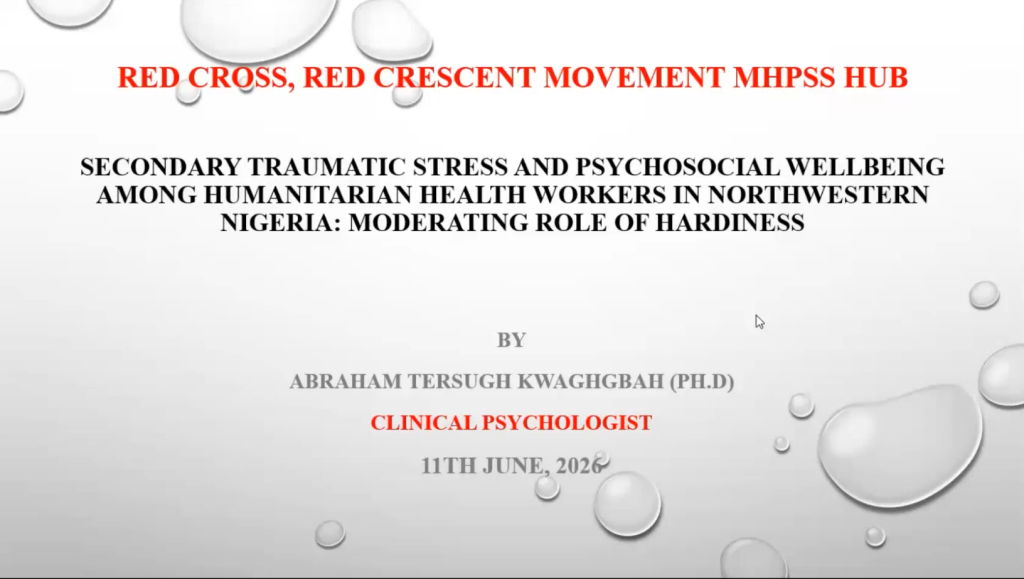
Webinar: Traumatic stress and psychosocial wellbeing among humanitarian health workers
In this webinar organized by the Red Cross Red Crescent Research Network Dr. Abraham Tersugh Kwaghgbah explores the moderating role of hardiness between secondary traumatic stress and psychosocial wellbeing among humanitarian health workers in Northwestern Nigeria.
It addresses the following key questions:
- What are some of the evidence-based interventions that can be used to support humanitarian workers to promote their psychosocial wellbeing?
- Can MHPSS practitioners in the humanitarian sector also be victims of secondary traumatic stress?
- What are some of the challenges of conducting research in emergency settings?
The session is moderated by MA Sc Julia Noethiger, Specialist in Trauma-Psychotherapy at the Swiss Red Cross and co-chair of the Red Cross and Red Crescent Research Network on MHPSS.
Abraham Tersugh Kwaghgbah holds a Bachelor of Science degree in Psychology, Master of Science degree in Clinical Psychology, Doctorate degree in Clinical Psychology from Benue State University Makurdi in Nigeria. He worked as a Clinical Psychologist for NGOs specifically Doctors Without Borders, Society for Family Health and currently with Ada S. McKinley Community Service Inc in the US. The title of his Doctors thesis is: The moderating role of hardiness between secondary traumatic stress and psychosocial wellbeing among humanitarian health workers in Northwestern Nigeria.
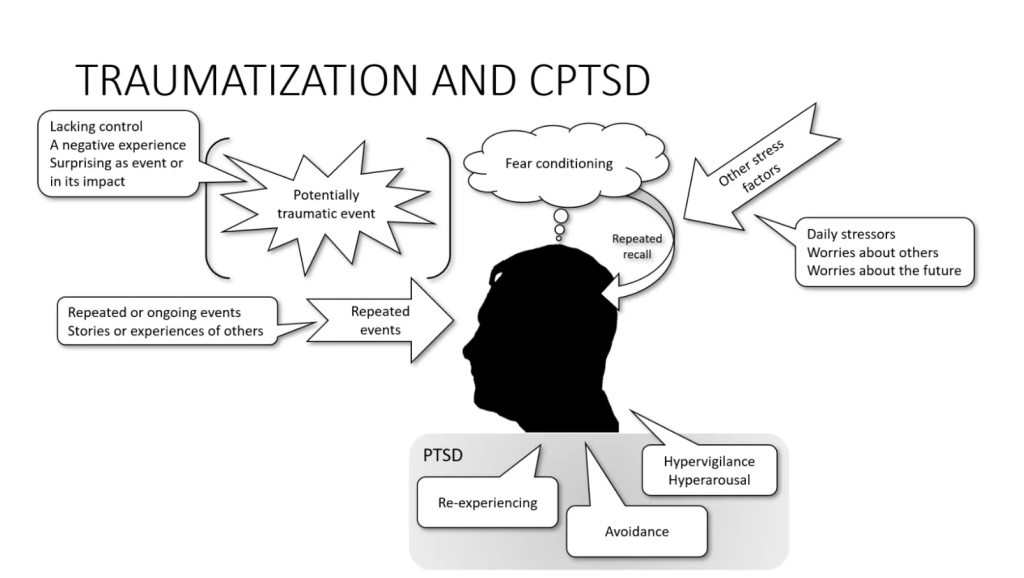
Journal Club session: Cultural Concepts of Distress and Complex PTSD
In the sixth Journal Club Session organized by The Red Cross Red Crescent Research Network, Dr. Ferdinand Garoff will present based on the article: Cultural concepts of distress and complex PTSD: Future directions for research and treatment.
Ferdinand Garoff is a Doctor of Psychology, psychologist (specializing in forensic psychology) and psychotherapist. He holds a PhD in the mental health of refugees from the University of Helsinki. He has previously worked as a psychologist at the Rehabilitation Centre for the Torture Survivors in Helsinki and in psychiatric care for children, adolescents and adults. He has been a member of the psychologist’s emergency response team of the Finnish Red Cross since 2006 and is also part of the international emergency response roster of the Finnish Red Cross and on the MHPSS roster of the ICRC. He has also worked abroad in countries including Denmark, Chechnya, Uganda, Nepal, Sierra Leone and Jordan for various international organisations.
The session is moderated by Dr. Sarah Davidson, the Head of Psychosocial and Mental Health at the British Red Cross.
Webinar: Mental health and well-being and the psychosocial dimensions of peacebuilding
This webinar recording features Dr. Katrien Hertog, Director of Peacebuilding Programs at the International Association for Human Values, sharing insights on the vital connections between mental health, psychosocial support, and peacebuilding. Drawing on over 25 years of experience, Dr. Hertog discusses practical approaches to trauma relief, mediation, and community resilience, highlighting how psychosocial perspectives can strengthen peacebuilding initiatives.
This resource is designed for practitioners, researchers, and students interested in sustainable peacebuilding and can be used as a learning tool to explore participatory, community-based strategies for addressing cycles of violence and promoting social cohesion.
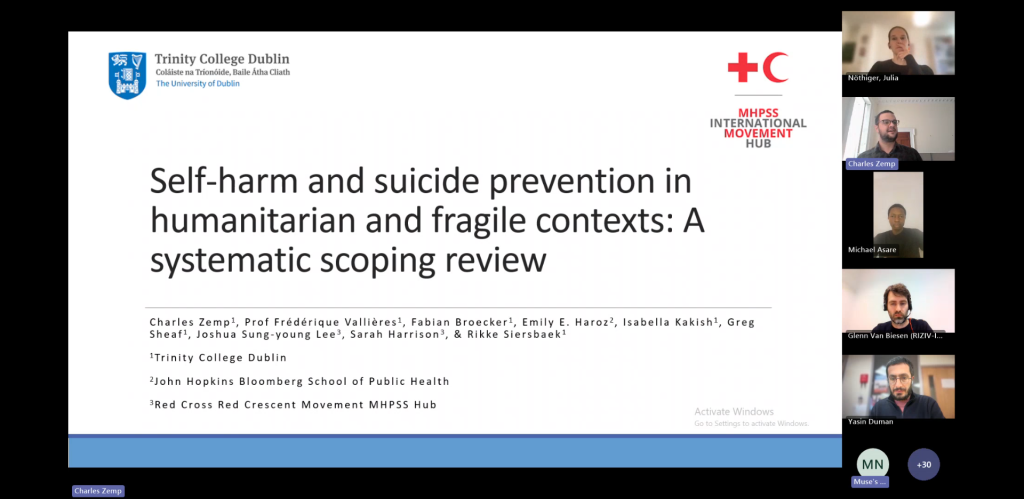
Webinar: Self-harm and suicide prevention in humanitarian and fragile settings
This webinar recording features Charles (Chad) Zemp, a PhD candidate at Trinity College Dublin, presenting the findings of a comprehensive scoping review on self‑harm and suicide prevention interventions in humanitarian and fragile settings. Recorded on 25 February 2026, it marks the first session in the Research Network’s new webinar series launched this year. The review synthesizes the global evidence base on prevention approaches implemented across diverse humanitarian contexts, highlighting current practices, knowledge gaps, and emerging directions for research and programme development.
The recording is intended for students, researchers, academics, and practitioners working in mental health and psychosocial support (MHPSS), and serves as a valuable learning resource, a research reference, and a practical tool to inform the design and strengthening of self‑harm and suicide prevention initiatives in humanitarian environments.
Webinar 2024: Integration of MHPSS in the Red Cross Red Crescent Movement
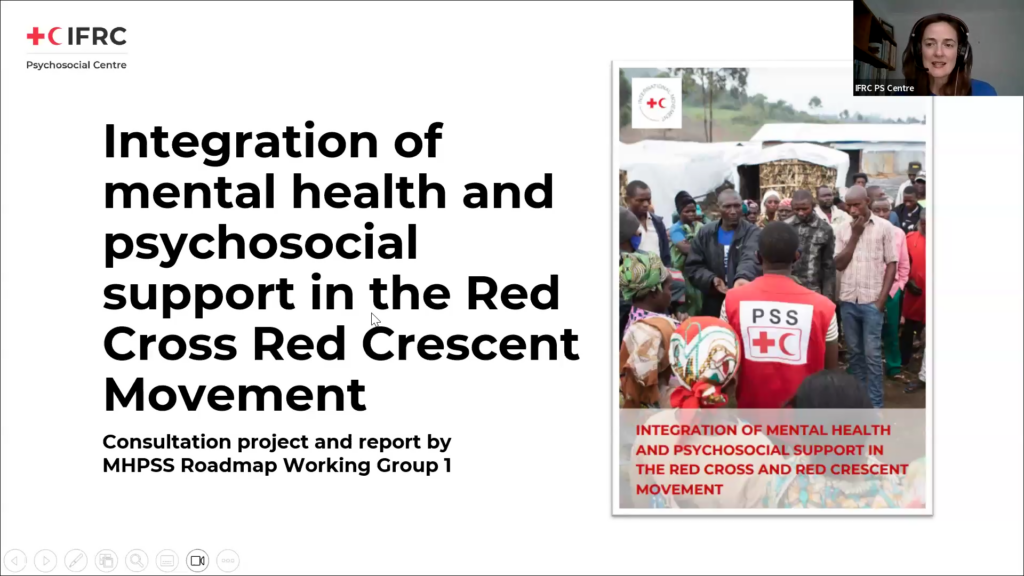
In 2019, the International Red Cross and Red Crescent Movement adopted a set of commitments for addressing mental health and psychosocial support (MHPSS) needs, holding the National Societies, the IFRC, and the ICRC accountable for guaranteeing a basic level of psychosocial support. Integrating MHPSS across sectors allows the Movement components to reach more people and ensure that persons in need of more specialized MHPSS services are identified and properly referred. Integration is also critical to reducing stigma, discrimination and exclusion.
This webinar focuses on the insights and recommendations of a consultation process carried out by Working Group 1 of the MHPSS Roadmap (co-lead by Shona Whitton, Technical Advisor at the IFRC PS Centre and Sarah Davidson, Head of Psychosocial and Mental Health at the British Red Cross) with 35 practitioners from National Societies, the ICRC and the IFRC, who have been involved in integrating MHPSS activities within the Movement. Two of the participating National Societies talk about their challenges and experiences with the integration of MHPSS approaches and services into an epidemic response and in an emergency response setting.
The presenters are:
- Ernest P. Nyame-Annan, Coordinator for MHPSS and First Aid at the Ghana Red Cross Society
- Serah Kalumbilo, Health Promotion Officer at the Zambia Red Cross Society
- Shona Whitton, a Technical Advisor in Mental Health and Psychosocial Support at the IFRC’s Psychosocial Centre
Presentations
Webinar 2024: Digital MHPSS to reach the most vulnerable
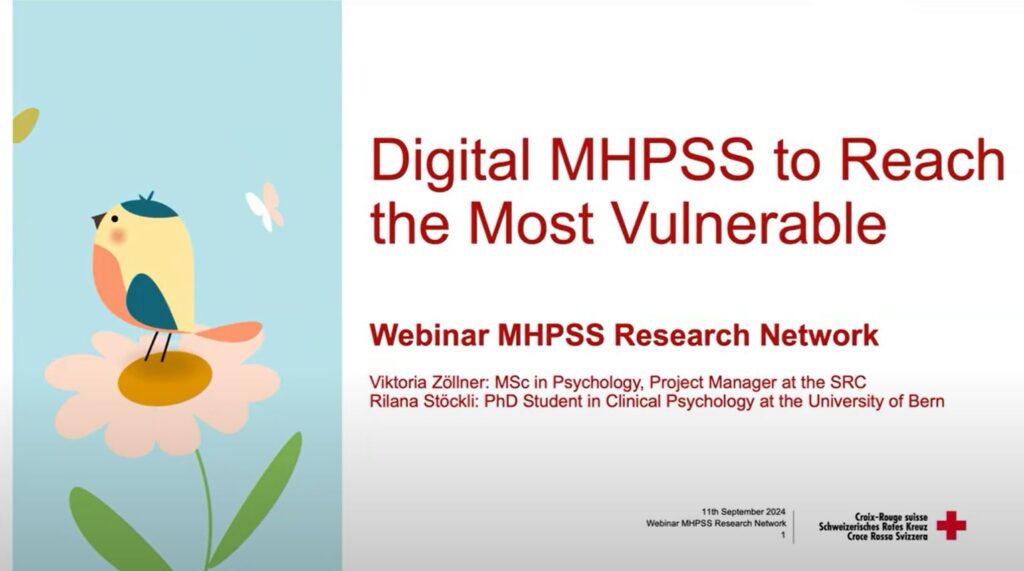
There is an enormous gap in human resources for mental health and psychosocial support at a global level. The ramifications of this gap are magnified in situations of armed conflict, natural disasters and other emergencies, where needs intensify and healthcare systems are overwhelmed. Accordingly, there is a need for innovative and promising MHPSS approaches that can reach more people affected in the most cost-effective way possible. In contexts where resources are scarce, access is limited, and gaps in service provision are high, digital psychological and psychosocial support services open up ways of connecting with more people in need. They provide a scalable and resource-efficient extension of traditional approaches to mental health care and psychosocial support.
This webinar provides an overview of the current state of research on digital MHPSS, discusses challenges with the development and the implementation of a scalable technology-empowered service and gives insights into the results of a very recent RCT on the acceptance and effectiveness of the Sui SRK App, a digital psychosocial intervention for refugees in Switzerland, developed and implemented by the Swiss Red Cross.
The presenters are:
Viktoria Zöllner, a Project Manager at the Swiss Red Cross for digital MHPSS, holding a master’s in psychology. She is co-leading the SRC project ‘Digital psychological and psychosocial support for refugees in Switzerland’ as part of which the Sui SRK app was developed.Rilana Stöckli, a PhD student of psychology at the University of Bern, was leading the research project concerning the process of cultural adaptation and conducting the RCT on the acceptance and effectiveness of the Sui SRK App.
Workshop on Journal Manuscript Submission 2024
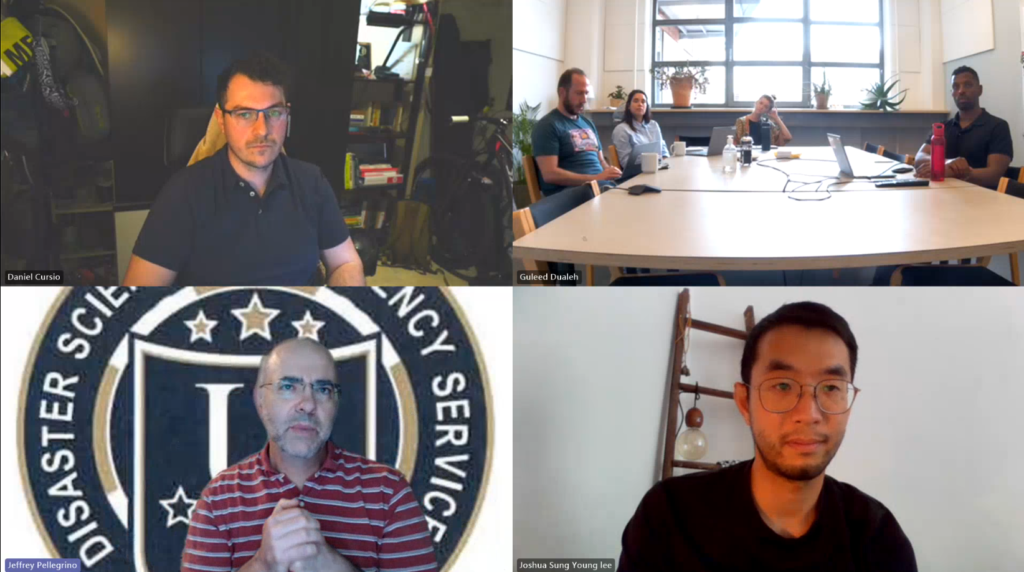
Online workshop with representatives from the International Journal of First Aid Education (IJFAE) explaining the process for submitting to the IJFAE specifically. The session allowed participants to socialize their ideas around the Chain of Survival Behaviors, articulate key messages, and begin to outline a manuscript.
2024 Webinar: Mental Health and Climate Change
Climate change contributes to and exacerbates a range of humanitarian crises for populations in every region of the world. The direct and indirect impacts on mental health and well-being at individual and community levels are concerning and often neglected.
In 2023, the International Federation of Red Cross and Red Crescent Societies (IFRC) Reference Centre for Psychosocial Support initiated a consultation process with the aim to better understand the intersection between mental health and psychosocial support (MHPSS) and climate change in the work of National Societies. This webinar presents a high-level overview of the climate-related mental health risks as identified by the consulted National Societies and discusses potential pathways to addressing the mental health and psychosocial challenges arising from the climate crisis.
The presenters are:
Shona Whitton, a Technical Advisor in Mental Health and Psychosocial Support at the IFRC’s Psychosocial Centre specialising in MHPSS in emergencies, climate change and protection, gender and inclusion.
And Finja Katharina Daegling, a Consultant at the IFRC’s Psychosocial Centre with a focus on the complex psychosocial impact of the climate crisis on mental health and well-being.
2019 Webinar: Moral Injury: Expanding our Understanding of Trauma
The concept of moral injury has become increasingly popular over the past years to describe“the lasting psychological, social and spiritual harm caused by actions that transgress a person’s deeply held moral beliefs and expectations“ But what does that actually mean? In this webinar, we unpack the concept of moral injury by asking three key questions:
- What is the concept of moral injury and how does it expand our understanding of trauma?
- What does the research on moral injury in relation to refugees show us?
- How can we use the concept in relation to humanitarian workers?
2017 Webinar: PFA: Between Evidence and Practice
- Why is the evidence-base for PFA so limited?
- What are the challenges for conducting research on PFA?
This webinar address these questions.
- Eliza Cheung, Clinical psychologist, Hong Kong Red Cross and Technical Advisor, PS Centre
- Koen van Praet, Clinical psychologist, Belgian Red Cross (Flanders)
- Ferdinand Garoff, Psychologist, University of Tampere
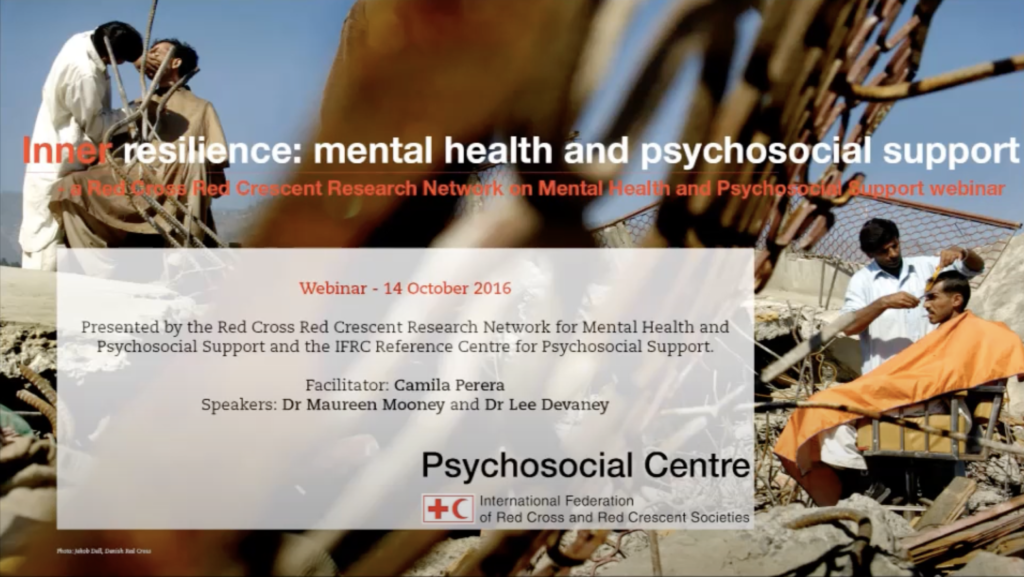
2016 Webinar series: Inner Resilience
A three part webinar series on Inner Resilience – Mental health and psychosocial support
2007 Webinar: Five Essential Principles of Psychosocial Interventions
In 2007, Stevan E. Hobfoll published a key article on post-disaster psychosocial support with a team of international experts Five essential elements of immediate and mid-term mass trauma interventions: Empirical evidence. Accordingly, psychosocial support after disasters or other traumatic events should promote five essential principles:
Sense of safety, Calming, Self- and community efficacy, Social connectedness, Hope
In the 10 years following their publication, the five essential principles have been extremely influential among practitioners, researchers and policy makers around the world. But how have the five principles been used, or misused? Are they useful and appropriate in measuring outcomes of psychosocial interventions? And what is next for MHPSS research?
In conversation with Dr. Leslie Snider, Dr. Stevan E. Hobfoll examines these questions during a one-hour webinar hosted by the Red Cross Red Crescent Research Network on Mental Health and Psychosocial Support.